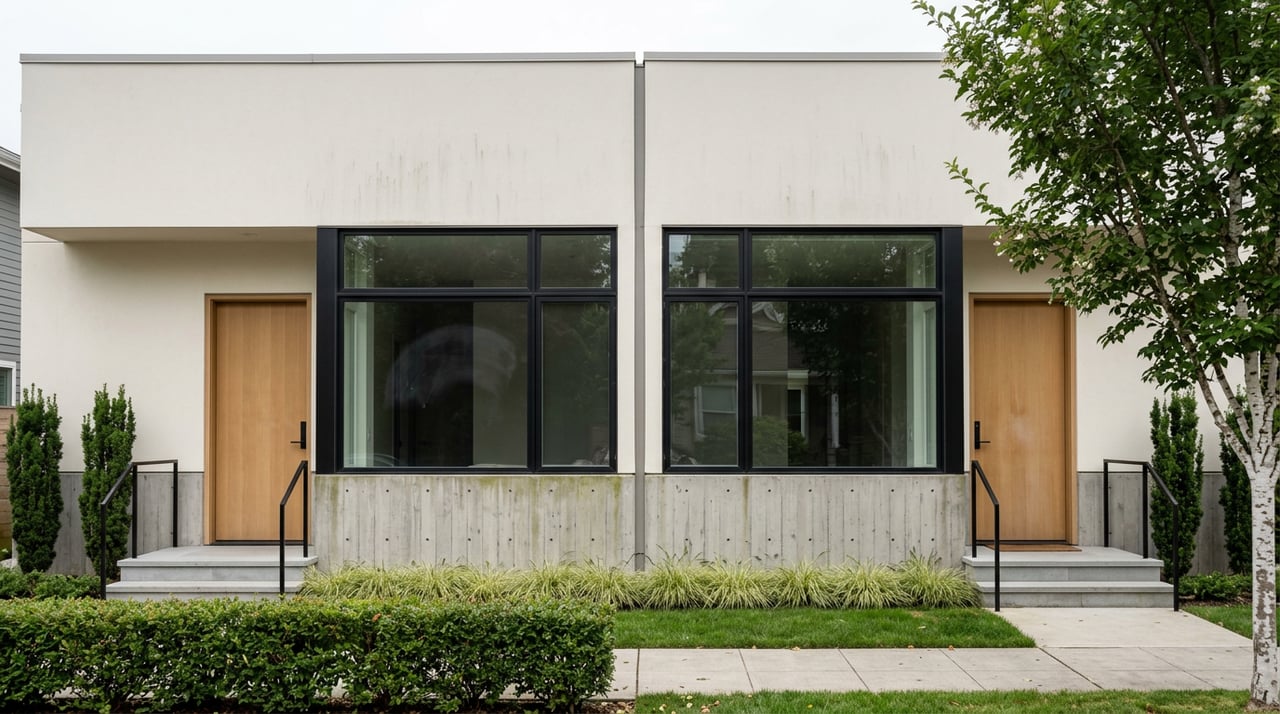
Watertown's Zoning Rewrite Made Headlines. The Number That Actually Moves a Multi-Family Deal Is Buried Two Paragraphs Down
August 27, 2026
August 27, 2026
A client called me in July with a spreadsheet already built. She had run the numbers on a five-unit building near the Arsenal corridor, then run the same math on a four-unit building two doors down, and couldn't understand why her lender treated the two properties like they belonged to different species. One call to underwriting explained it. At four units, she was buying a house with tenants. At five, she was buying a commercial asset, full stop.
That threshold, not the zoning notice that's been circulating around Watertown Square, is the fact that decides what a multi-family purchase actually costs to close here in 2026.
Watertown adopted new zoning for the Watertown Square area in November 2024 to comply with the state's MBTA Communities Law, and the Massachusetts Executive Office of Housing and Livable Communities confirmed the city's compliance on April 9, 2025. The figure attached to that story everywhere you read it is 1,701, the minimum unit capacity the state law required the city to zone for.
That's the floor, not the ceiling. What the Watertown City Council actually approved allows by-right development to reach more than 4,000 units, according to the Charles River Regional Chamber's coverage of the unanimous vote, more than double the state's mandated minimum.
Here's the part that gets skipped whenever that bigger number gets repeated: the city's own zoning FAQ is explicit that unit capacity is not a construction forecast. It's the theoretical maximum if every parcel in the district got redeveloped to the top of what zoning now allows, all at the same time, which is not how real estate markets behave. The city's own next steps for the Watertown Square Area Plan describe issuing requests for qualifications to hire consultants for street and site design work, which is early-stage planning language, not the language of a market about to be flooded with finished apartments.
For anyone underwriting a 2026 acquisition, that distinction is the whole ballgame. Zoning capacity tells you what's legally possible over a horizon measured in years, maybe decades. It tells you nothing about what you'll be competing against next quarter.
While the zoning capacity conversation plays out over years, the visible multi-family market has stayed tight. Active multi-family listings in Watertown have been running at roughly four to five at any given time this spring, with list prices clustering around $1.1 million to $1.15 million, and full multi-family sale prices in town ranging from under $1 million to well over $2 million depending on unit count and condition. Small multifamily deals in the inner Boston suburbs are generally being underwritten this year at going-in cap rates somewhere between 3.5% and 6%, with the tighter end reserved for well-located, well-maintained properties.
The gap between "zoned for 4,000 units" and "four to five listings on the market" is exactly the gap between legal capacity and lived inventory. If you're pricing a deal today, the second number is the one that should be setting your competitive comps.
The financing threshold my client discovered sits underneath all of it:
| Property Size | Loan Type | Typical Down Payment | Underwriting Focus |
|---|---|---|---|
| 2 to 4 units | Residential investment loan | 20% to 25% | Borrower's personal income plus rental income |
| 5 or more units | Commercial multifamily loan | Roughly 25% to 30% (70% to 75% LTV) | Property's net operating income and debt service coverage ratio, typically 1.25x minimum |
That line at five units has nothing to do with zoning capacity and everything to do with how you'll need to structure your offer, your reserves, and your timeline before you write a purchase and sale agreement.
If a wave of new supply were genuinely imminent, you'd expect rental demand near the Arsenal corridor to be softening in anticipation. It isn't. In April 2026, the ALS Therapy Development Institute signed a 33,310-square-foot lease at 200 Arsenal Yards Blvd, according to Hoodline's reporting on the deal, joining a roster of life-science tenants at the campus that already includes Abata Therapeutics, Remix Therapeutics, Curie Therapeutics, and Vigil Neuroscience. That leasing activity sits on top of Alexandria Real Estate Equities' earlier moves in the corridor, including its purchase of the former athenaHealth campus for $525 million and its acquisition of the former Watertown Mall for $130 million, both long-horizon institutional bets on Watertown's life-science future.
That's a well-paid, growing workforce landing in Watertown regardless of what the zoning ceiling eventually allows. It's a far more immediate driver of rental demand than a theoretical unit count that may take a decade or more to test.
If investors genuinely believed Watertown was about to be oversupplied with new multifamily buildings, you'd expect rents on larger units to already be softening in anticipation, since bigger floor plans are typically the first product a developer builds at scale. The 2026 rent data runs the opposite direction. Studio, one-bedroom, and two-bedroom rents in Watertown rose between roughly 4% and 5.5% year over year through the first half of 2026, while three- and four-bedroom units fell by about 9% and 3% over the same period.
That's not what a supply glut looks like. It looks like a market where smaller households, many of them commuting to the Arsenal corridor or into Cambridge, are absorbing whatever small-format inventory exists faster than it can be replaced, while larger units, often the back half of an older triple-decker, face more resistance. If you're deciding on a unit mix for a value-add project or weighing whether to subdivide a large unit into two smaller ones, that split matters more to your rent roll than any zoning capacity figure.
Watertown's multi-family stock skews old. A large share of the city's housing predates 1979, with a meaningful portion built before World War II. Older buildings usually mean older systems, from undersized electrical panels to aging boilers, and a higher likelihood of lead paint compliance requirements on anything built before 1978. None of that shows up in a zoning notice. It shows up in an inspection report, and it belongs in your capital reserve budget well before you get to a cap rate.
The other number worth having ready before you underwrite anything in town is the fiscal year 2026 residential tax rate of $12.20 per $1,000 of assessed value, since property taxes are typically the largest non-mortgage line item on a small multifamily property here.
None of this makes the zoning story fake, and more housing capacity in Watertown Square is not bad news for the town. It just means the headline number, whether you hear 1,701 or the larger approved figure, describes a ceiling that will take years to test, not a forecast of what lands on the market this fall. If you're underwriting a Watertown multi-family purchase in 2026, the numbers already showing up in signed leases and closed sales matter more: a financing structure that changes entirely at five units, an active listing count you can count on two hands, a life-science tenant roster still signing five-figure-square-footage leases at Arsenal Yards, and a rent pattern that currently rewards smaller units over larger ones.
Does the new Watertown Square zoning affect the two-family or triple-decker I already own? Only if your property sits inside the district's mapped boundaries and you're proposing new construction or a change of use that requires zoning relief. The change makes multi-family development by right within that mapped area going forward. It doesn't retroactively rezone or reassess anything outside the plan area, and it doesn't require existing owners to do anything differently.
What actually pushes a small multifamily loan from residential underwriting into commercial territory? Unit count, not zoning designation. Once a property has five or more units, lenders typically move to commercial multifamily underwriting, evaluating the deal on the property's net operating income and debt service coverage ratio rather than your personal income, with down payment requirements rising accordingly.
If you're weighing a Watertown multi-family purchase, or trying to figure out whether a building you already own pencils out under today's financing terms, Home Search with ZZ can walk through the underwriting with you, unit by unit. Get a free home valuation or schedule a consultation with Zahra to talk through the deal in front of you, not the zoning map behind it.




Experience a real estate journey defined by dedication, personalized service, and a deep understanding of Massachusetts’ vibrant communities. Whether you’re buying, selling, or simply exploring, Zahra’s expert guidance ensures a smooth and rewarding process tailored to your needs.